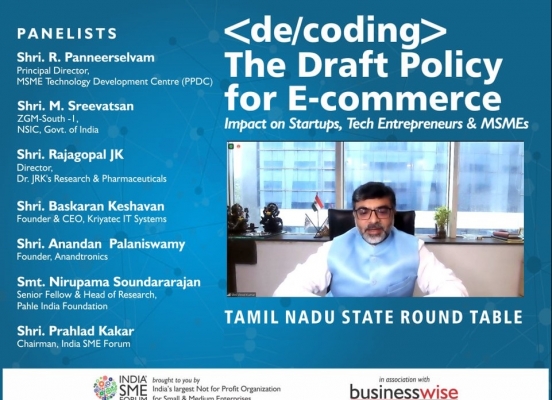
Decoding the Draft Policy for E- Commerce - Tamil Nadu
60 million people could lose their livelihoods because of the draft rules Significant impact on Local Traders

New draft e-commerce rules can ruin the potential of 6.89 lakhs MSMEs in Tamil Nadu: Industry experts
The e-commerce space has not only helped consumers during the pandemic but also helped the small and medium businesses to sustain. Often referred to as the manufacturing and economic powerhouse of India, Tamil Nadu continues to be a vibrant industrial state. With a large base of big factories and small units, the state has approximately seven lakh registered MSMEs, including the ones relying heavily on e-commerce as it is the most sustainable channel to facilitate a post-pandemic economic recovery.
Recently, the Tamil Nadu government unveiled a new MSME policy. In recognition of the impact and contribution to the economy, the government wants to ensure that MSMEs in Tamil Nadu are provided with an enabling framework to grow and set the state on the path of recovery. The policy aims to bring in investments worth INR 2 lakh crore and also create 20 lakh jobs by 2025. However, the recently issued amendments to draft e-commerce rules aim to restrict innovation and opportunities for small businesses on these platforms. If the draft e-commerce rules are implemented in its present form, the entire MEME policy of Tamil Nadu will be endangered as it causes multiple hassles for MSMEs. Sharing his opinion on this, Mr. Vinod Kumar, President, India SME Forum, said, “The amendments increase compliance burden on e-commerce entities and make the marketplace inaccessible to small and medium businesses who depend on these entities for sustenance. It is important for the government to revisit these rules and detangle the complexities.”
Shri. M. Sreevatsan, GM-South -1, National Small Scale Industries Corporation, Govt of India, highlighted, “B2B businesses have not been taken into consideration in the draft e-commerce rules. This policy has not been drafted with a holistic approach and leaves a number of players behind.
Shri. Rajagopal JK, Director, Dr. JRK's Research & Pharmaceuticals Pvt Ltd, said, “While the government is trying to rein in big players, it will actually end up trampling smaller players in e-commerce. The rules seek to ban flash sales, and promotions and advertisements by sellers. As the bulk of consumers in India are from the middle class, these promotions provide a significant boost to sales in India.”
Smt. Nirupama Soundarajan, Senior Fellow & Head of Research, Pahle India Foundation, said, “The more strict you become with a marketplace, there will only be so much a marketplace can do. With fall back liability, e-commerce will get choked. Only the most organised sellers will be able to get on the platforms due to the strict requirements. MSMEs in e-commerce will be dead and won’t make the cut for entry. Regulations can’t come at the cost of market development. The draft rules are doing just that.”
Shri Baskaran Keshavan, Founder & CEO, Kriyatec IT Systems, also stressed, “The draft rules are oblivious to B2B players in e-commerce. The one size fits all approach is not right for e-commerce and there are too many grey areas in this law. Women entrepreneurs, particularly, that have come up during the pandemic will be greatly affected due to the compliance proposed by the new rules.”
Shri. R. Paneerselvam, Principal Director, MSME Tech Development Centre (PPDC), pointed out, “SMEs have been pushed into e-commerce and are not as well equipped to cope with the requirements of giants such as Amazon and Flipkart. The draft rules will make it even harder for them.” Experts have also raised concerns about how these rules, if implemented, can have an obstructive impact on the economic development of the country with respect to job opportunities, scope for the growth of MSMEs, global investments, and consumer experience.
Key concern areas highlighted by industry experts:
- Ambiguous and overreaching measures
The amendments aim to ban discounted sales on e-commerce platforms which allow many small sellers, artisans, weavers, craftsmen, homemakers to sell their goods around festive seasons at attractive prices. These sales are a big source of revenue for small businesses and if the changes are approved, these can hurt consumers as well as local and household sellers. Additionally, ban on these sales foster a demarcation between physical and online retail. Sales in the offline marketplace doesn’t go through the same amount of scrutiny as is placed on online platforms.
- Cause unnecessary disruption and create entry barriers
Online platforms provide small sellers an opportunity to showcase their local products with a wider set of audience. Issued amendments like mandatory registration with DPIIT will create stringent burdens for online platforms, which may force them to change the way they conduct their business. This will, in turn, impact sellers, who will not be able to use such platforms to their advantage.
- Compliance burdens can break MSMEs and startup ecosystem
The changes will also affect extended support levied by e-commerce platforms for assurance of smooth business transactions like transport, shipping, delivery, and other support service providers associated with the same. Currently, small sellers are able to avail these support services at competitive prices due to the low-cost business model offered by online platforms. Due to the increased compliance burden of support service providers, small sellers will be unable to avail these services at cost-effective rates.
- Interference with ease of doing businesses and volatility
The appointment of officers, registration formalities, and submissions of proofs and documents will affect small sellers who conduct business through their own websites. Small businesses don’t have the appropriate means to abide by the norms proposed by the new guidelines which makes the online marketplace inaccessible to them and disrupt the ease of doing business.
The participating sellers and India SME Forum (ISF) were in consensus that the draft rules will cause irrevocable damage to MSMEs. Having withered two waves of a devastating pandemic, MSMEs need all the support they can get from policy makers. The draft rules are not only counterproductive but will be more damaging in the long run than COVID itself since these rules will be permanent. In this regard, the sellers and ISF have agreed to approach the government and make their voices heard before the 21 July deadline.

You may also like