India SME Forum Hosts World Futures Forum to Shape MSME Future | 11th-12th February 2026

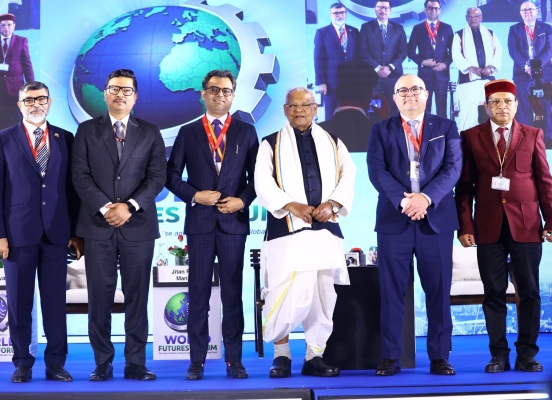
The World Futures Forum 2026, hosted by India SME Forum in collaboration with the United Nations Industrial Development Organization (UNIDO), was held on 11-12th February in New Delhi, bringing together global policymakers, industry leaders, development institutions, and innovators to deliberate on how artificial intelligence and digital transformation can reshape the future of MSMEs in the Global South. The forum, themed “The Future of Industry, Enterprise and Livelihoods in the Global South,” served as a precursor to the AI Impact Summit led by the Ministry of Electronics and Information Technology and focused on equipping small businesses with the tools, partnerships, and policy frameworks needed to enhance competitiveness, innovation, and sustainable growth.
A key highlight of the inaugural day was the launch of the AIM Global India Chapter by Chief Guest Shri Jitan Ram Manjhi, Hon’ble Minister of MSME, who, in his keynote address said, “Despite the scale of our MSME initiatives, their impact has not reached rural India in the way it should. The realities of villages are very different from cities. Income is uncertain, skills are informal, migration is forced, and access to tools, credit, and markets remains limited. If MSME efforts remain confined to cities and semi-urban areas, India’s real challenges will not be addressed. India is a country of villages, and MSME growth must reach the grassroots. There is a strong need to actively promote and spread awareness of MSME schemes in rural areas, by visiting villages, communicating in local languages, and directly involving rural people. Only when MSMEs are taken to villages in a planned and inclusive manner will migration reduce, sustainable livelihoods be created, and true national development be achieved”
In his host address, Mr. Vinod Kumar, President of India SME Forum, highlighted how the Global South is emerging as a co-creator of the future industrial order, leveraging AI and digital technologies to build equitable growth pathways. He said, "In the era of artificial intelligence and transformative technologies, the Global South is rising not as a follower, but as a powerful architect of tomorrow's world, forging global leaders who harness AI to drive inclusive innovation, empower enterprises and livelihoods at scale, bridge historical divides, and ensure that the future of industry, growth, and opportunity is shaped equitably from New Delhi to every corner of the emerging economies."
UNIDO leaders echoed this perspective, with Mr. Alejandro Rojas noting that India’s strong MSME ecosystem, digital public infrastructure, and industrial clusters position it as a global model for inclusive, technology-driven transformation. Across the first day, sessions explored practical approaches to strengthening industrial clusters, leveraging intellectual property, and aligning MSMEs with international quality standards to reduce trade barriers and improve market access. Experts shared global case studies and policy insights, while discussions on innovation and digitalisation highlighted the growing role of AI, Industrial IoT, and collaborative research in accelerating enterprise growth.
The second day shifted the spotlight to applied AI and digital inclusion, examining how technologies such as predictive maintenance, automation, and advanced analytics can boost productivity and competitiveness in manufacturing. Deliberations also focused on building inclusive digital economies through open-source tools, digital public infrastructure, and cross-border cooperation. A major highlight was the roadmap for AI-focused Centres of Excellence in partnership with states, emphasising digital skilling, workforce readiness, plug-and-play infrastructure, and simplified compliance as critical enablers for MSME scaling. Sessions on cross-border e-commerce explored how digital platforms, logistics networks, and data-driven insights can help MSMEs expand into global markets, while live demonstrations showcased real-world applications of AI and robotics in supply chains, quality inspection, and energy management.
Innovation remained a strong theme throughout the forum, with the Open Innovation Challenge 2026 presenting selected solutions from over 150 submissions aimed at improving productivity, sustainability, and competitiveness. Research presentations on ethical AI, circular business models, and digital governance added further depth, highlighting the need for responsible and inclusive technology adoption. In the closing reflections, speakers emphasised that translating dialogue into action will require continued collaboration among governments, industry, and global institutions to address persistent challenges such as market access, financing, and skills gaps.
Summing up the two days, Ms. Sushma Morthania, Director General of India SME Forum, expressed gratitude to partners and participants while outlining next steps, including the expansion of AIM Global Chapters and new cluster development initiatives. The forum ultimately reinforced India’s growing role as a leader in AI-enabled industrial transformation and Global South cooperation, setting the stage for deeper partnerships and concrete initiatives aimed at empowering MSMEs to drive inclusive and sustainable economic growth worldwide.

You may also like