India’s Export Promotion Mission: A Bold Bet on Small Business Going Global

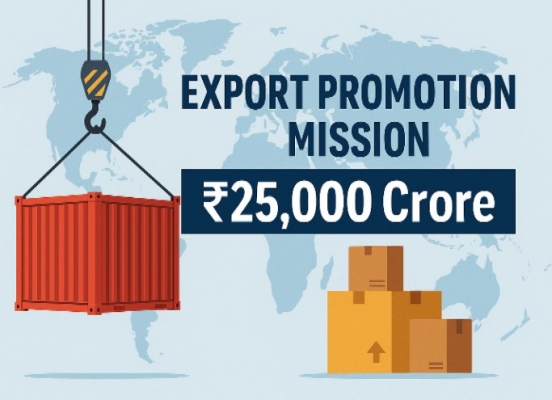
On February 20, 2026, India’s Ministry of Commerce did something unusual for a government agency: it released a policy that was not vague. The Export Promotion Mission, or EPM, landed with a stack of trade notices, budget outlays, and operational guidelines that left little room for ambiguity. The headline figure was ₹25,060 crore allocated across fiscal years 2025-26 through 2030-31. But the more interesting story lies in the plumbing.
The EPM is not a fund. It is a friction-reduction machine built specifically for India’s 63 million micro, small, and medium enterprises, the shoemakers in Agra, the leather tanners in Kanpur, and the textile weavers in Tirupur. These businesses have long had competitive products. What they have lacked is the financial architecture to send those products to the world.
The Two Pillars: Money and Momentum
The EPM is split into two operational halves. The first, Niryat Protsahan, handles financial support and receives ₹10,400 crore of the budget. The second, Niryat Disha, covers ecosystem and logistics support with the remaining ₹14,660 crore. Both are administered through a single gateway: the DGFT’s new Trade Connect e-Platform, a fully paperless digital portal that integrates directly with customs data systems.
The integration with customs data is not a minor detail. It eliminates what exporters have historically called the “proof of export” bottleneck, the weeks-long process of submitting physical documentation to prove that goods actually left the country. Under the new system, the platform already knows. The data talks to itself.
Fixing the Cash Flow Crisis: Export Factoring
For a small manufacturer, the cruellest feature of international trade is its payment timeline. You ship your goods to a buyer in New York. You now own an invoice due in 90 days. Meanwhile, your factory workers expect their wages on Friday.
Export factoring addresses this directly. Under the EPM scheme, a manufacturer can sell that outstanding invoice to a financier (a “factor”), receive immediate cash, and let the factor worry about collecting from the overseas buyer. The EPM makes this dramatically cheaper by offering a 2.75% interest subvention, effectively a government subsidy on the financing cost.
But the headline feature is non-recourse factoring. Under this structure, if the overseas buyer defaults, the factor absorbs the loss, not the MSME. The small manufacturer keeps the cash received on day one. It is, in effect, export insurance embedded directly into the transaction. The scheme is capped at ₹50 lakh per MSME annually and covers 4,139 specific tariff lines, with an emphasis on labour-intensive, margin-thin sectors.
The E-Commerce Frontier: Lending Against Overseas Inventory
Traditional banks have a collateral problem with e-commerce exporters. If you lend against a factory, you can seize the factory. But if a seller’s assets are a thousand individual parcels scattered across warehouses in New Jersey and Frankfurt, what exactly is the security?
The EPM introduces a direct e-commerce credit facility with up to ₹50 lakh backed by 90% government guarantee coverage, effectively de-risking the bank’s exposure to near zero. More remarkable still is the overseas inventory credit facility: Indian banks will now lend against stock sitting in foreign warehouses, up to ₹5 crore, with 75% guarantee coverage and the same 2.75% interest subvention.
The practical implication is significant. To compete on platforms like Amazon US or European marketplaces, a seller needs goods physically present in local fulfilment centres, not a shipping container three weeks away. Until now, prepositioning inventory abroad required either deep pockets or creative financing. The EPM removes that barrier.
Quality, Geography, and the Pineapple Problem
Financial liquidity means nothing if your product cannot clear foreign customs. The TRACE initiative (Trade Regulations, Accreditation, and Compliance Enablement) tackles this by reimbursing certification costs, CE marks, FDA certifications, and organic standards at 60% for general exporters and up to 75% for priority sectors. The annual cap is ₹25 lakh per exporter code.
The logistics question is handled by LIFT (Logistics Interventions for Freight and Transport). Any manufacturing unit located more than 200 kilometers from a designated seaport or gateway qualifies for up to 30% reimbursement of eligible freight costs, capped at ₹20 lakh per year. The scheme explicitly lists agricultural commodities like walnuts, mandarin oranges, and pineapples from northeastern India.
The pineapple example is not incidental. Assam produces world-class pineapples. Assam is also extremely far from any major seaport. The trucking cost to Kolkata or Mumbai historically consumed the entire profit margin before the fruit reached an international buyer. LIFT is designed to artificially flatten India’s internal geography until its infrastructure catches up.
Building Presence Abroad: FLOW and MAS
The FLOW initiative (Facilitating Logistics, Overseas Warehousing, and Fulfillment) provides direct financial assistance of up to 30% of project costs for businesses setting up or leasing space in overseas warehousing facilities for three years. The policy explicitly supports hubs like the Bharat Mart project in Dubai, a large integrated showroom-warehouse for Indian goods in the UAE, and similar facilities being developed across Africa and Europe.
The Market Access Support (MAS) program goes one step further: it reimburses airfare. Specifically, micro-exporters with turnover under ₹75 lakh who travel to Africa, the Americas, or Oceania for approved buyer-seller meets and trade delegations can claim up to 75% of their airfare, capped at ₹1.25 lakh per trip. The condition is participation as part of a unified, branded Indian delegation, a deliberate move to prevent the fragmentation of Indian businesses appearing as dozens of unrelated, tiny entities at global trade expos.
The Strategic Timing: Resilience, Not Just Growth
The EPM was not released in a benign trade environment. February 2026 is a period of significant global trade disruption: rising US tariff barriers, rolling EU carbon levies, and the end of the frictionless multilateral trade order that defined the 1990s. Reading the Commerce Minister’s notes alongside the policy documents, the word “resilience” appears repeatedly.
The MAS airfare reimbursement, notably, is concentrated on Latin America, Africa, and Oceania, not the United States or Europe. The message is deliberate market diversification. India has concluded free trade agreements covering access to 70% of global GDP. The EPM is designed to be the vehicle that actually gets small exporters through those doors before they need a backup plan, not after.
Critically, the EPM is a coordinated cross-government effort. The Reserve Bank of India is extending timelines for the realisation of export proceeds, giving exporters more breathing room. The Finance Ministry has concurrently approved an additional ₹20,000 crore in credit guarantee support. The Commerce Ministry cannot fix exports alone; it needs the central bank and commercial banks on board, and in this case, they are.
What 2030 Could Look Like
Imagine a leather jacket manufacturer in Kanpur in 2030, if the EPM executes as planned. He logs into the Trade Connect portal. He finds a buyer in Italy. He uses LIFT to reimburse 30% of the truck bringing his jackets to Mumbai port. He already has European quality certification, paid for mostly by TRACE. He uses export factoring to unlock immediate cash the moment his shipment departs. His goods are already in a Milan warehouse, financed against overseas inventory credit.
None of this requires a multinational’s balance sheet or a corporate department dedicated to export compliance. That is the ambition of the EPM: to make global trade a realistic option for the small manufacturer who has always had the product but never had the system.

You may also like