The Government has expanded the Export Promotion Mission (EPM) with seven new measures to boost MSME
Piyush Goyal Introduces Seven New Interventions Under Export Promotion Mission

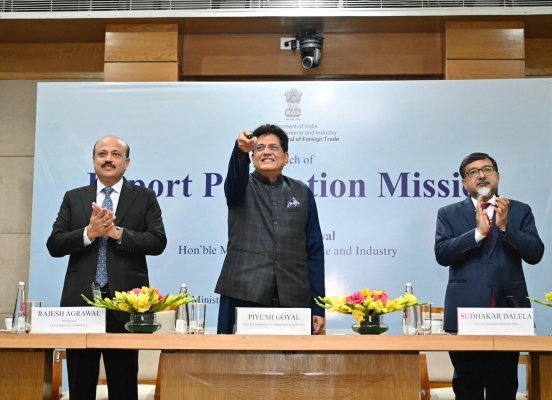
The Government has expanded the Export Promotion Mission (EPM) with the launch of seven new interventions aimed at strengthening the participation of Micro, Small and Medium Enterprises (MSMEs in global trade). The initiative, launched by Piyush Goyal, Union Minister of Commerce and Industry, marks a significant policy effort to address long-standing challenges faced by small exporters and to make India’s export growth more inclusive.
The announcement comes at a time when India has recorded double-digit growth in merchandise exports in February, reflecting strong global demand and renewed confidence in Indian industry. Speaking on the occasion of the World Day of Social Justice, the Minister emphasised that export-led growth must reach the last entrepreneur in the value chain, particularly MSMEs, startups and first-time exporters operating beyond traditional export hubs.
Moving from Fragmented Schemes to an Export Ecosystem
Unlike earlier export schemes that focused on individual issues in isolation, the Export Promotion Mission adopts an ecosystem-based approach. It combines financial support under Niryat Protsahan with trade facilitation and infrastructure support under Niryat Disha, delivered through a unified and digitally monitored framework.
The Mission is being implemented by the Department of Commerce in coordination with the Ministry of MSME, Ministry of Finance, EXIM Bank, credit guarantee institutions, regulated lending institutions, Indian Missions abroad and industry bodies. With this launch, 10 of the 11 proposed interventions under EPM are now operational.
For MSMEs, this integrated structure is significant. Small exporters often struggle with multiple authorities, complex paperwork and delayed reimbursements. The Mission seeks to simplify access to support while directly addressing key bottlenecks such as working capital shortages, compliance costs, logistics disadvantages and market entry risks.
Financial Support Focused on Cash Flow and Risk
Under Niryat Protsahan, three interventions focus on easing financial stress for MSMEs and improving access to export credit.
- Export factoring has been promoted as a practical working capital tool for MSMEs facing long payment cycles from overseas buyers. Under this intervention, exporters will receive an interest subsidy of 2.75% on the cost of export factoring for eligible transactions carried out through RBI- or IFSCA-recognised entities. Financial assistance is capped at ₹50 lakh per MSME per year and will be processed through a digital claims mechanism, enabling exporters to convert export invoices into immediate cash without waiting months for payment.
- To support exporters using digital platforms, structured credit facilities have been introduced specifically for e-commerce exports, backed by interest subvention and partial credit guarantees. Under the Direct E-Commerce Credit Facility, MSMEs can access loans of up to ₹50 lakh with 90% credit guarantee coverage. In addition, the Overseas Inventory Credit Facility provides support of up to ₹5 crore with 75% guarantee coverage for exporters maintaining inventory in foreign markets. Both facilities carry an interest subvention of 2.75%, subject to an annual ceiling of ₹15 lakh per exporter, reducing borrowing costs and improving access to formal credit.
- Support has also been extended for exporters exploring new or higher-risk international markets. Through shared-risk financing and credit support instruments, this intervention seeks to strengthen exporter confidence and liquidity, encouraging MSMEs to diversify beyond traditional export destinations and build resilience in an uncertain global trade environment.
Reducing Compliance and Logistics Barriers
Under Niryat Disha, four interventions address non-financial but equally critical challenges faced by MSME exporters.
- The Trade Regulations, Accreditation & Compliance Enablement (TRACE) initiative supports MSMEs in meeting international testing, inspection and certification requirements, which are often a major cost barrier to entering developed markets. Exporters can receive reimbursement of 60% of eligible expenses under the Positive List and 75% under the Priority Positive List, subject to a maximum limit of ₹25 lakh per Import Export Code (IEC) per year. This enables small exporters to meet global standards and compete in higher-value segments.
- The Facilitating Logistics, Overseas Warehousing & Fulfilment (FLOW) intervention supports access to overseas warehousing and fulfillment infrastructure, including e-commerce export hubs integrated with global distribution networks. Financial assistance of up to 30% of the approved project cost will be provided for a maximum period of three years, subject to prescribed ceilings and MSME participation norms. This allows exporters to store goods closer to overseas buyers, reduce delivery time and improve competitiveness.
- To address geographical disadvantages, the Logistics Interventions for Freight & Transport (LIFT) scheme provides reimbursement of up to 30% of eligible freight and transport costs, subject to a ceiling of ₹20 lakh per IEC per financial year. The intervention is aimed at exporters in low export-intensity districts, helping inland and remote MSMEs compete more effectively in global markets.
- Finally, the Integrated Support for Trade Intelligence & Facilitation (INSIGHT) intervention focuses on exporter capacity-building, district- and cluster-level facilitation under the Districts as Export Hubs initiative, and development of trade intelligence systems. Financial assistance of up to 50% of project cost is available, with up to 100% support for proposals from Central and State Government institutions and Indian Missions abroad, subject to notified limits.
Conclusion
For MSMEs, the expanded Export Promotion Mission offers a clear opportunity to optimise costs, strengthen cash flows and reduce risks associated with global expansion. Firms with regular overseas orders can leverage export factoring to shorten receivable cycles, while those exporting through digital channels or maintaining inventory abroad can align their financing strategies with the new e-commerce credit and guarantee facilities to lower borrowing costs. MSMEs looking to enter new or non-traditional markets can also use the shared-risk instruments under the Mission to expand with greater confidence.
To translate these measures into tangible gains, timely engagement will be critical. As the Mission moves from policy design to on-ground implementation, exporters that actively align their financing, logistics and market expansion plans with the available interventions will be best placed to convert government support into sustained export growth and stronger global competitiveness.

You may also like