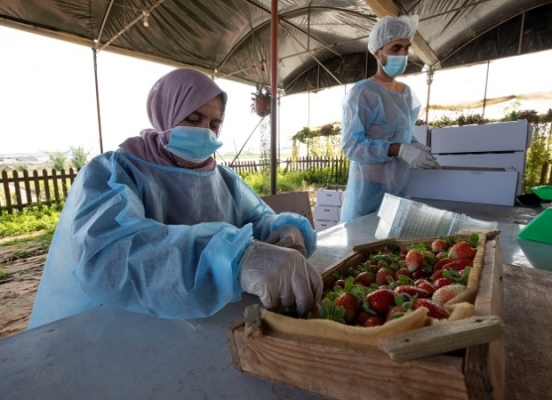
Palestinian project of ITC changes format of its project to help Palestinian farmers
Palestinian project of ITC changes format of its project to help Palestinian farmers

The emergence of Covid-19 in the world has wrought destruction and devastation in far flung countries.
But it had had its advantages too. Like in the long run, the pandemic has driven home the importance of being adaptable and adopting to new technologies. The International Trade Centre (ITC) changed the format of its project to help Palestinian farmers boost their income and shift to digital channels. It now supports more companies and has a more significant impact than initially envisioned.
The project initially targeted 10 businesses in the West Bank and Gaza. It involved training via a study tour and visits to international trade fairs at which matchmaking events were planned. The switch to online and virtual activities in the wake of the pandemic means more beneficiaries, more project components and more concrete work.
'It's more effective because we will be ready and equipped to reach more customers and enter more foreign markets since the project is accompanied by programmes to develop packaging, promotional and marketing activities,' said Yasmeen Dado, project coordinator at the Cooperative Union for Marketing Cooperative Products. 'This will improve our ability to reach more markets because we are in the stage of developing our products and building our capabilities,' she added.
The project that was modified after a survey of Palestinian farmers and food processors in early May, found that the pandemic had severely affected the economy of the State of Palestine. Then 35 per cent of the 29 micro, small and medium-sized enterprises (MSMEs) interviewed did not expect to survive.
It was then that ITC followed up with a strategy outlining what steps were to be taken to ease the impact of COVID-19 on the project particularly in light of mobility restrictions and efforts to prevent the spread of the virus. For instance, ITC decided to provide virtual one-on-one coaching when a Gaza workshop on marketing plans was cancelled.
The survey and the risk mitigation plan led to the decision to switch to online activities, said ITC project manager Eman Beseiso. Instead of face-to-face webinars and exhibitions, the project turned to activities to enhance the virtual matchmaking and marketing skills of SMEs so that they could meet online buyers and generate leads, she added.
'The online and virtual activities are better to enable us to keep pace with technological developments and to create accounts for social media,' Beseiso said.
This new approach is helping 25 MSMEs manage their online marketing functions and connect with buyers through virtual platforms and channels.
Instead of the two planned initially, a team of 10 local and international experts was formed to work on digital marketing and quality aspects with exporters. The project's travel budget was reallocated. These firms now learn about the requirements of international markets and commercial opportunities by participating in virtual study tours and online events.
'We delivered webinars on digital marketing, and we are also providing coaching and advisory,' Beseiso said.
'We are using the resources allocated for trade fairs and exhibitions for digital marketing and online skills. This is more sustainable and will help the companies in the long term more than a one-time business-to-business event or a one-time exhibition.'
ITC is also building a matchmaking platform (Palestianfood.net) that will feature the profiles of project participants. This will help buyers in target markets see what products are available from the Palestinian agribusinesses and connect with them. The platform will be up and running this month.
ITC recruited two photographers, three digital marketing experts and two copywriters to help the businesses develop professional content for their websites and social media campaigns.
ITC and the Food and Agriculture Organisation of the United Nations are collaborating on the project which aims to help producers of dates, olive oil, strawberries, fresh herbs, and spices, including freekeh and za'atar. Denmark, the Netherlands, the European Union, Switzerland and Spain are funding the initiative.
As part of the project, ITC has been speaking to officials of three companies in the Netherlands interested in buying fresh strawberries from Gazan producers, Ms. Beseiso said. ITC is working with logistics companies in the West Bank that might help export the berries, and a meeting is planned in the coming days. 'We are trying to find complete solutions,' she said. 'We might be able to have some concrete results very soon,' she ended.

You may also like