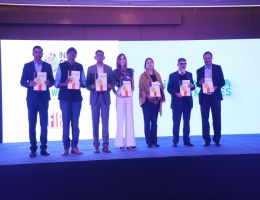
India SME Forum Brings MSMEs Face-to-Face with GST Authorities; Sector Flags Critical Compliance Pain Points Under GST 2.0

New Delhi, November 29, 2025 – The India SME Forum (ISF) today convened MSME entrepreneurs, senior GST officials, logistics operators, and e-commerce platforms for a high-level stakeholder consultation, GST Samvaad 2.0, creating a first-of-its-kind direct dialogue on the persistent compliance hurdles under GST 2.0. MSMEs flagged several pressing challenges, including rising compliance costs, documentation overload, registration bottlenecks and cancellations—particularly around shared premises—and difficulties in availing Input Tax Credit (ITC). Participants also highlighted concerns over the lack of a level playing field due to varying Goods Transport Agency (GTA) tax positions taken across different e-commerce platforms, as well as ITC accumulation issues that have intensified after recent rate reductions.
The session opened with remarks from Dr. Sasmit Patra, Member of Parliament (Rajya Sabha), and was followed by discussions led by senior officers from the CGST Delhi Zone and the Directorate General of GST, alongside ISF leadership. More than 60 MSME entrepreneurs highlighted real on-ground issues and stressed the need for clearer interpretational guidance, smoother RCM processes for GTA services, and digital tools tailored for small businesses navigating evolving rules. The insights shared will form the basis of a formal ISF submission to GST authorities outlining today’s challenges and recommendations.
Speaking at the forum, Dr. Sasmit Patra said, “MSMEs should not be spending more time and money complying with GST than building their businesses. If compliance costs can be halved, if a notice no longer triggers fear and uncertainty, and if yearly time spent on GST can drop from 15 hours to five, we unlock enormous entrepreneurial energy. Simplification isn’t a convenience—it’s a growth imperative.”
Highlighting the severity of compliance burdens, Vinod Kumar, President, India SME Forum, noted, “We have trained nearly 4,500 entrepreneurs on GST filing and ITC claims, yet only a fraction could complete the process. A business with ₹1.5 crore turnover spending ₹2–6 lakh a year just to stay compliant is simply untenable. Complexity is draining both capital and capacity from small businesses.”
Senior GST officials—including Shri Prakash Singh Rawat (AAD, DGGST), Shri Vinayak Chandra Gupta (Chief Commissioner, CGST Delhi), Shri Pawan Kumar (Commissioner, CGST Delhi-East), Shri MD. Irfan Aziz (Commissioner, CGST Delhi-West), Shri Prashant Kumar Jha (Additional Director, DGGST), and Dr. Shafali G. Singh (Director, GST Council)—acknowledged the concerns raised and reaffirmed the government’s commitment to addressing them. Officials noted that a comprehensive departmental study identifying pain points across registrations, refunds, cancellations, and revocations is in its final stages, with findings to be submitted to the Board shortly for targeted corrective measures.
The recommendations emerging from the GST Samvaad are expected to contribute to improved policy clarity, reduced compliance friction, and stronger ease of doing business for MSMEs across logistics, transport, manufacturing, and digital commerce value chains.

You may also like