Key Developments at the 47th GST Council Meeting

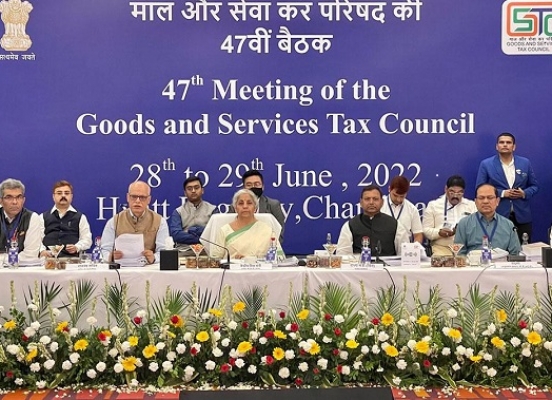
On June 28 and 29, 2022, the 47th GST Council meeting took place, nearly coinciding with the fifth anniversary of GST. The GST Council's deliberations were primarily about IT reforms, fixing the GST rate on online gambling, and rationalizing the GST rate. The GST Council meeting had several important outcomes, including reducing exemptions and introducing trade facilitation measures. The Council decided to increase tariffs on a variety of goods and services (such as LED lamps, solar water heaters, leather, and works contract services for specified works) in order to correct the inverted duty structure and prevent the accumulation of input tax credits resulting in blockage of working capital.
A number of exemptions on goods and services have also been withdrawn, including taxes on hotel accommodations priced up to Rs 1,000 and hospitalisation (except ICU) costing more than Rs 5,000 per day. Given the current level of high inflation in the nation, an increase in GST rates might not be appropriate. The Council has postponed consideration of the recommendation for a 28 percent sin rate on gaming in casinos, at horsetracks, online gaming has been deferred by the Council and the matter is to be re-examined. Online gaming would be negatively impacted if it were subject to a 28% tax. Therefore, before raising the rate to 28 percent, it is necessary to discriminate between skill-based games and games of chance.
The Council has made a number of clarifications regarding the taxability of goods and services, including the treatment of preferential location charges (PLC) as part of the consideration for land, and the application of a 5 percent GST to all electric cars, battery pack or not (which is not subject to GST). With this clarification, the automobile industry would profit from a concessionary rate of 5% on the sale of electric vehicles, even when they are offered without battery packs. Additionally, treating PLC as a factor in land consideration may help the real estate sector to some extent by lowering consumer costs.
Special measures for MSMEs have been implemented to facilitate trade by removing the obligation for mandatory GST registration for individuals whose annual revenue does not exceed a predetermined threshold. Additionally, MSMEs under the composition scheme are now permitted to use e-commerce platforms. It has been a long-awaited request by the SME and MSME sectors to have access to large e-commerce platform, even though the plan needs to be carried out and would tentatively be implemented with effect from 1 January 2023.
Other essential trade facilitation measures include the following:
- Refunds under an inverted duty structure are suggested to be permitted for input services, which will stop credit from building up.
- It is proposed to exempt the time period from the limitation period for submitting refund applications or issuing demands or orders (by the proper officer) in relation to incorrect returns from 1 March 2020 to 28 February 2022. Extension of the return limitation period is anticipated to decrease current lawsuits due to the rejection of refunds being time-barred and increase taxpayers' need for operating capital.
The Council has also proposed to clarify some of the following aspects:
- Various issues concerning the interpretation of provisions relating to ITC availment restrictions.
- Issue of perquisites provided by an employer to employees per a contractual agreement
The Council has suggested creating a ministerial panel to provide recommendations for suitable modifications to the CGST Act in response to the long-awaited demand to establish a Tribunal under GST law. The creation of the Tribunal will assist taxpayers in appealing to it and lessen the workload of court cases at different high courts around India.
Significant progress has been achieved in the last five years toward the government's "one nation, one tax" idea since the introduction of the GST. The perception of indirect taxes has altered as a result of the increased use of technology and the single GSTN platform for interactions between the government and taxpayers. The business community has praised the government's initiative to automate tax compliances and welcomed the switch to the GST. While great work has been made to simplify and streamline the GST system, this Council meeting, which took place shortly before the GST in India reached its fifth anniversary, also addressed a number of other concerns that required the government's attention.
Source: https://economictimes.indiatimes.com/small-biz/gst/key-developments-at-the-gst-council-meeting/articleshow/92612549.cms

You may also like