Navigating Licenses, Registrations and Regulations in India
A Practical Compliance Guide for MSMEs in the Food Business

Running a food business in India is as rewarding as it is demanding. Beyond crafting great products, food entrepreneurs must comply with a web of regulations from food safety norms to tax filings and labor laws. For Micro, Small and Medium Enterprises (MSMEs), understanding these requirements is not just a legal obligation; it is a strategic foundation for sustainable growth. This guide walks you through the key compliances your food business must meet, in a clear and actionable manner.
1. Start with Udyam Registration
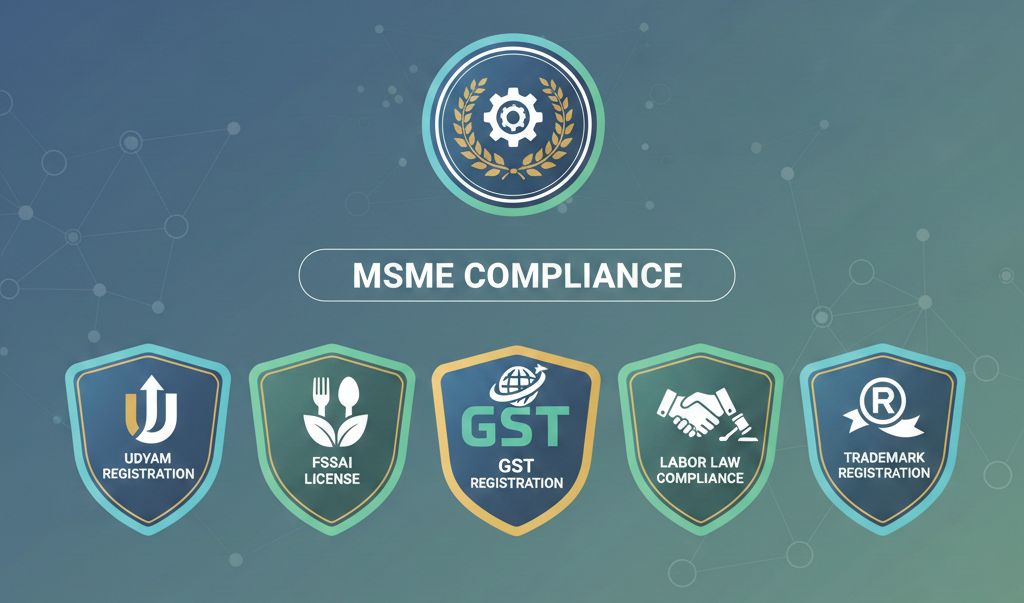
The first step for any food MSME is getting formally recognized by the Government of India through Udyam Registration. This process is entirely free, takes under 10 minutes and is done online at udyamregistration.gov.in. You simply enter your Aadhaar number, validate your PAN and GSTIN via OTP, fill in your enterprise's investment and turnover details and submit. Your certificate is issued instantly by email, no documents or fees required.
Why does this matter? Udyam registration unlocks significant benefits: access to government subsidies and priority-sector loans, an 80% rebate on trademark registration fees and enhanced credibility with banks and institutional buyers. The key caution here is accuracy misreporting turnover or investment can lead to reclassification and penalties.
2. Obtaining Your FSSAI License
Food safety compliance is non-negotiable in India's food industry. The Food Safety and Standards Authority of India (FSSAI) mandates that all food businesses be registered or licensed before they commence operations. The type of license depends on your scale:
• Basic Registration for businesses with annual turnover below ₹12 lakh
• State License for businesses with turnover between ₹12 lakh and ₹20 crore
• Central License for businesses exceeding ₹20 crore in turnover
The process involves downloading Form-A or Form-B from fssai.gov.in, creating an account on the FoSCoS portal, uploading identity and address proofs, a photograph and a premises layout. Fees range from ₹100 to ₹7,500 per year and approvals typically take 30 to 60 days including an inspection.
Once licensed, display your 14-digit FSSAI license number prominently, put up a purple Food Safety Display Board and ensure menu labels indicate calories and allergens where required. FSSAI registration is also mandatory if you wish to sell on platforms like Zomato or Swiggy. The investment in compliance here pays dividends in consumer trust.
3. GST Registration: Tax Compliance Done Right
Goods and Services Tax (GST) registration is mandatory if your annual turnover exceeds ₹20 lakh (₹10 lakh in special category states) or if you sell through online food aggregators regardless of turnover. Registration is done through gst.gov.in: select 'New Registration,' enter your PAN, mobile number and email, verify via OTP, upload your PAN, address proof, bank details and photograph and receive your GSTIN within 3 to 7 days.
If your turnover is under ₹1.5 crore, consider the Composition Scheme a simplified option where you pay a flat tax of 1–5% and file returns quarterly instead of monthly. This can significantly reduce the compliance burden for smaller units. The broader advantage of GST registration is access to input tax credits, which lower your effective cost of production and eligibility to sell across a wider market.
4. Labor Law Compliance
If your food business employs staff, even a handful you are required to register under the Shops & Establishments Act of your respective state. The process involves submitting identity proofs, employee details and a lease agreement through your state's labor portal and paying a fee based on staff count. Your registration certificate must be displayed prominently at the premises.
Key obligations include paying state-mandated minimum wages, maintaining attendance and wage records and ensuring working hours do not exceed 9 hours per day. For businesses with 10 or more workers, EPF (Employee Provident Fund) and ESIC (Employee State Insurance Corporation) contributions also become applicable.
Key Notes: Penalties for labor law non-compliance can reach up to ₹1 lakh. Formalizing your employment practices early protects your business and your workers.
5. Protecting Your Brand: Trademark Registration
Your brand name, logo and packaging are valuable business assets. Trademark registration protects them by granting you exclusive rights and legal recourse against copycats. For MSMEs, the government has made this more accessible. The official fee is just ₹4,500 (compared to ₹9,000 for others), a direct benefit of your Udyam registration.
The process involves filing Form TM-A on ipindia.gov.in, conducting a trademark availability search, submitting your logo and business details, paying the fee and responding to any examination objections. Post-publication, third parties have the opportunity to oppose the mark before it is finally registered. The entire process takes 12 to 18 months but grants protection for 10 years, renewable indefinitely.
Visit: ciprpf.com (Intellectual Property Facilitation Centre) for Brand Registration Consultancy.
6. Safety and Environmental NOCs
Fire NOC
Any food establishment, especially one with a commercial kitchen must obtain a Fire No Objection Certificate from the state Fire Department. Submit your site plan and proof of fire safety systems; an inspection is typically conducted within 10 days. The provisional NOC must be renewed annually for premises exceeding 500 sq. meters or with significant seating capacity. This is also a prerequisite for most commercial insurance policies.
Pollution Clearance (CTE/CTO)
Food processing units must obtain Consent to Establish (CTE) and Consent to Operate (CTO) from the State Pollution Control Board (SPCB). Most food businesses fall under the Green category, which means the process is simplified. You will need to submit your premises layout and details on emissions or effluents. These approvals are critical if you plan to expand or set up new facilities.
PESO License for LPG Storage
If your unit stores petroleum products or LPG beyond a certain quantity, a license from the Petroleum and Explosives Safety Organisation (PESO) is required. This involves submitting Form VII/VIII along with vessel certifications. The requirements include maintaining defined safety distances and firefighting equipment on-site.
7. Recommended: HACCP & ISO 22000
While not legally mandatory for most MSMEs, food safety management standards like HACCP (Hazard Analysis and Critical Control Points) and ISO 22000 are highly recommended particularly if you target exports or institutional clients. These frameworks require you to form a food safety team, map your production flows, identify critical control points and verify processes regularly.
The upfront investment in training and infrastructure can be challenging for small businesses, but the long-term payoff of global market credibility, reduced product recalls and stronger buyer relationships makes it a worthwhile aspiration as your business grows.
The Road Ahead: Compliance is not a one-time task it is an ongoing commitment. The good news is that every registration and license you secure makes your food business more credible, more scalable and more resilient. Start with Udyam and FSSAI registration, then layer in GST and labor compliances as you grow. For city-specific requirements, especially in metros like Mumbai, consult a compliance professional to navigate local regulations. Remember: non-compliance risks fines of ₹2 lakh or more and in serious cases, shutdowns. The cost of compliance is always lower than the cost of being caught without it.
Quick Tip: Your food MSME's compliance journey starts with two simple, low-cost steps: register for Udyam at udyamregistration.gov.in along with your brand's Trademark, and obtain your FSSAI license at fssai.gov.in. These foundational registrations give your business its legal identity without burdening your budget.

You may also like