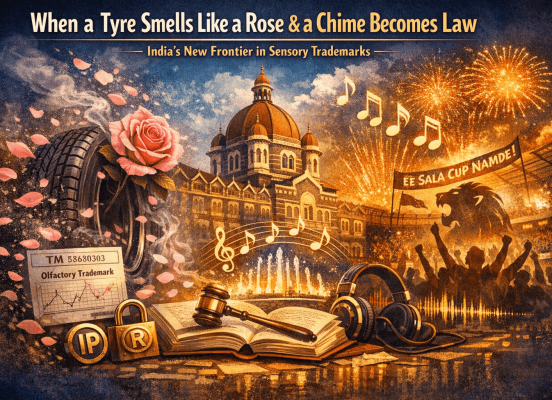
When a Tyre Smells Like a Rose and a Chime Becomes Law, You Know Branding Has Changed Forever

Close your eyes and imagine stepping into a Taj Hotel lobby. Before you see the marble floors or hear the soft piano, something else registers a subtle fragrance, a warmth in the air, a quiet chime that seems to say: you have arrived somewhere exceptional. Now imagine that chime five precise notes ascending in D Major is not just a design choice. It is a legally registered trademark. Owned. Protected. Enforceable.
Welcome to the frontier of intellectual property, where India is no longer just catching up, it is setting the pace.
Between late 2025 and early 2026, India's Trade Marks Registry made a series of decisions that quietly shook the world of brand law. A Japanese tyre company secured the first-ever olfactory trademark in India for a tyre that smells like roses. A legendary hotel chain trademarked its signature audio identity. And a beloved cricket franchise locked down the electrifying sounds of its stadium. These were not gimmicks. They were the opening moves in a profound redefinition of what a brand can be.
 The Tyre That Smelled Like a Rose Garden
For three decades, Sumitomo Rubber Industries quietly infused its tyres with a delicate floral fragrance, the unmistakable scent of roses. Since 1995, every tyre rolling off the production line carried this signature, cutting through the sharp chemical smell of rubber that customers had come to expect and dread. It was a small detail that made a world of difference. But could a smell be a trademark?
In November 2025, the answer became a resounding yes. The Controller General of Patents, Designs and Trade Marks, Unnat P. Pandit, approved application No. 5860303 making it India's first registered olfactory trademark. The road to approval, however, was anything but fragrant.
The core challenge was deceptively simple: how do you represent a smell in a legal document? A logo can be printed. A jingle can be notated. But a scent? Authorities worldwide have long struggled with this question and many, including the European Union, have simply declined to register olfactory marks because they cannot be represented with sufficient precision.
India found a solution where others had not. Researchers at the Indian Institute of Information Technology (IIIT), Allahabad, developed what they called a 7D olfactory vector, a scientific graph that mapped the rose fragrance across seven sensory dimensions: floral, fruity, woody, nutty, pungent, sweet and minty. Suddenly, something as ephemeral as a scent had a precise, reproducible, objective fingerprint. Gas chromatography and mass spectrometry backed up the claim, proving the fragrance's chemical consistency. Affidavits confirmed that Indian consumers had come to associate the scent specifically with Sumitomo, a quality lawyers call 'acquired distinctiveness.'
The approval met the exacting global standard known as the Sieckmann criteria, a benchmark from a 2002 European Court of Justice ruling demanding that any trademark be clear, precise, self-contained, easily accessible, intelligible, durable and objective. India had not merely accepted a smell mark. It had engineered a legal and scientific framework to do so rigorously. The precedent, now advertised in Journal No. 2236, opens the door for olfactory trademarks across industries from luxury textiles to hospitality to pharmaceuticals.
Five Notes That Define a Legacy
 The Indian Hotels Company Limited better known as the custodians of the Taj brand has spent over a century crafting one of the world's most storied hospitality identities. The Taj Hotels name consistently ranks among the strongest hotel brands globally. So when the company's leadership decided to formalise their auditory identity, they were not building from scratch. They were protecting something that had always existed in their guests' memory.
In January 2026, IHCL secured India's first sound mark in the hospitality sector. The ‘Taj Sonic' , a five-note melody progressing D–E–E–G–A–E in D Major, became legally protected intellectual property. It is a deceptively simple sequence. Warm, unhurried, slightly regal. But compressed within it is an entire brand philosophy: the promise of unhurried luxury, of being seen and cared for.
Sound trademarks have been recognised under Indian law since amendments in 2017, requiring applicants to submit musical notation or digital audio files as graphical representation. The concept itself is not new Yahoo's yodel, Nokia's ringtone and the MGM lion's roar are all registered sound marks in various jurisdictions. What makes the Taj Sonic significant is the deliberateness of the registration in a category of luxury hospitality where emotional memory is everything.
Rajendra Misra, Executive Vice President at IHCL, framed it plainly: the Taj Sonic reinforces the brand's position through innovative intellectual property. In an era where guests encounter a brand on social media, on television, in podcasts and in hotel lobbies, owning your sonic signature is as essential as owning your logo. The registration ensures that no competitor can imitate the sound that millions have learned to associate with the quiet confidence of a Taj welcome.
The Roar of the Stadium as Intellectual Property
If the Taj Sonic is luxury bottled into five notes, then Royal Challengers Bangalore's sound mark is something altogether wilder: the barely-contained energy of a packed cricket stadium.
 RCB's 'Ee Sala Cup Namde' a battle cry that translates roughly to 'This year, the cup is ours' has been the rallying anthem of their passionate fanbase since the earliest days of the Indian Premier League. It is a sound born not in a recording studio but in the collective throat of tens of thousands of fans. Now, the franchise has taken steps to extend that anthem, alongside its stadium soundscape lion roars, rock guitar riffs, dhol beats, fan chants under formal trademark protection.
The move is strategically astute. In cricket's hyper-competitive commercial landscape, fan loyalty is among the most valuable assets a franchise can possess. By trademarking the auditory 'vibe' of its stadium experience, RCB is asserting that the emotional atmosphere it has cultivated over nearly two decades is, in a meaningful legal sense, its own. Rivals can field players. They cannot imitate the particular electricity of an RCB crowd. The registration ensures that if anyone tries to commercially exploit that identity, that specific sound, that specific feeling they will face legal consequences.
The Legal Architecture Behind the Revolution
What makes India's embrace of sensory trademarks particularly remarkable is that it required no new legislation. The Trade Marks Act of 1999 contains an admirably broad definition of what constitutes a mark, one that does not restrict protection to visual signs. India's Trade Marks Registry, drawing on this flexibility and the global Sieckmann framework, has simply chosen to apply the existing law with imagination and scientific rigour.
This stands in contrast to the European Union, which has largely rejected olfactory marks due to technological limitations in precise representation. The United States offers a middle path: the Clarke case famously registered a plumeria scent for sewing thread in 1990 but even American practice demands careful navigation of functionality doctrines (a scent that serves a practical purpose cannot be trademarked).
India's innovation lies in fusing law with science. The IIIT Allahabad vector approach is not just clever, it is a genuine contribution to global IP methodology. By creating an objective, reproducible, multi-dimensional representation of a scent, Indian researchers provided the legal infrastructure that trademark offices worldwide have been unable to build. If this approach is adopted internationally, India may find itself having not merely followed global trends, but having shaped them.
What Comes Next and What Must Be Watched
The implications of these registrations extend far beyond tyres, hotel lobbies and cricket stadiums. India's textile industry where specific fabric textures or finishes could become proprietary stands to benefit. The food and beverage sector, where distinctive flavours and aromas define premium products, is watching closely. The pharmaceutical industry, where scent is sometimes used to aid patient identification of medications, faces both opportunities and serious risks.
Not all the implications are straightforward. Critics raise legitimate concerns about sensory monopolisation, the prospect of corporations locking up generic scents or sounds that others depend upon. The enforcement challenges are real: proving that a competitor's product smells like yours requires the kind of expert olfactory analysis that courts are only beginning to develop frameworks for. There is also the question of scent depletion in a world where every major brand rushes to register its signature fragrance, will the palette of available smells narrow uncomfortably?
These are not reasons to abandon the project. They are reasons to build it carefully. India's Trade Marks Registry will need to develop clear guidelines distinguishing functional scents from arbitrary ones and generic sounds from distinctive ones. The Sumitomo precedent, for now, is encouraging: the rose scent passed muster precisely because it serves no functional tyre-related purpose. It is purely associative exactly what a trademark is meant to be.
A New Language of Branding
There is something quietly profound about the moment when a legal system acknowledges that identity is not only visual. Human beings experience brands the way they experience people through every available sense. We remember the smell of a grandmother's kitchen, the sound of a childhood theme song, the feel of a favourite fabric. Brands that understand this have always known that their most powerful asset is not their logo. It is the feeling they create.
India's Trade Marks Registry has now given legal form to that intuition. The rose-scented tyre, the five-note chime, the roar of a cricket crowd these are not curiosities at the margin of IP law. They are harbingers of a richer, more human conception of what it means to own a brand.
The next time you walk into a Taj Hotel and hear that gentle chime, you will be experiencing something that is, in a very real sense, protected intellectual property. The law has finally learned to listen.
For all The IPR related Help Connect to IPFCs which helps MSMEs to Register their Brand and get Reimbursement on your IPs - https://ciprpf.com/

You may also like